- Dr. Manisha Jain is a leading IVF and fertility specialist in Chandigarh
- +91-7719714768
- Manisha260710@gmail.com

Best Laparoscopy & Hysteroscopy Diagnostic Centres in Chandigarh

Top 10 Fertility Specialist in Chandigarh
October 16, 2026
Advanced IVF & ICSI Treatment in Chandigarh
October 16, 2026Best Laparoscopy & Hysteroscopy Diagnostic Centres in Chandigarh | Dr. Manisha Jain
Women’s health and reproductive wellness depend heavily on timely and accurate medical evaluation. When evaluating complex conditions such as chronic pelvic pain, unexplained infertility, abnormal uterine bleeding, or recurring miscarriages, standard non-invasive imaging like ultrasound may not always provide a complete visual picture. In such cases, specialized endoscopic evaluations become essential. Selecting the best laparoscopy & hysteroscopy diagnostic centres in Chandigarh ensures that patients receive precise evaluations, advanced medical care, and compassionate treatment under expert clinical guidance.
Under the expert care of Dr. Manisha Jain, a leading gynecologist, patients receive comprehensive clinical evaluations tailored to their specific reproductive health needs. Understanding how these minimally invasive diagnostic modalities work—and knowing what to look for when choosing the best laparoscopy & hysteroscopy diagnostic centres in Chandigarh—empowers women to make well-informed healthcare decisions.
Understanding Laparoscopy and Hysteroscopy
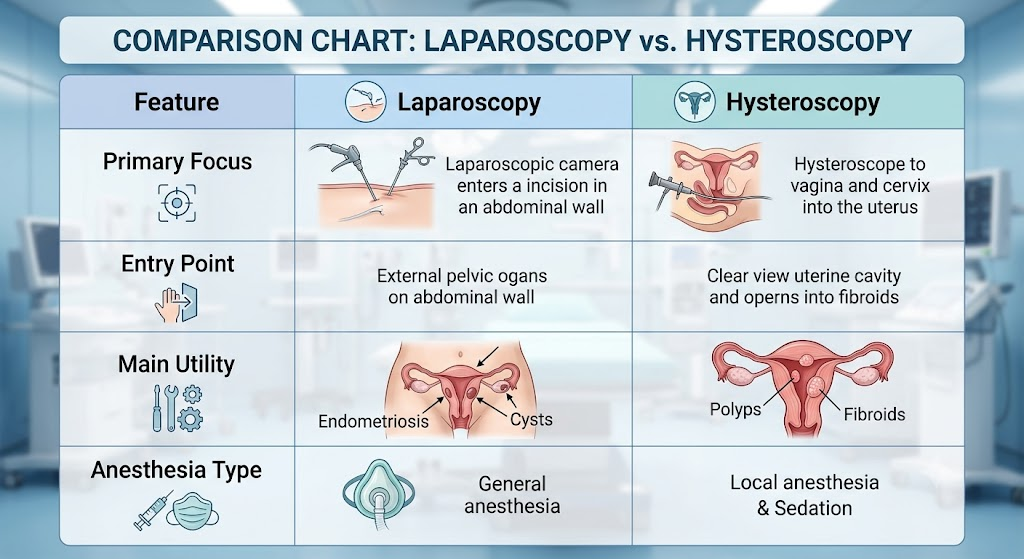
While laparoscopy and hysteroscopy are both minimally invasive endoscopic procedures used in modern gynecology, they examine entirely different anatomical areas and serve distinct clinical functions.
What is Laparoscopy?
Laparoscopy—often referred to as keyhole surgery—is a minimally invasive technique where a thin, lighted telescope (a laparoscope) is inserted through a small incision in the abdominal wall, usually around the belly button. This allows the specialist to directly view the pelvic organs, including the exterior surface of the uterus, ovaries, fallopian tubes, and surrounding peritoneum. Diagnostic laparoscopy is considered the gold standard for identifying pelvic conditions that remain invisible on standard ultrasounds.
What is Hysteroscopy?
Hysteroscopy involves inserting a ultra-thin lighted camera (a hysteroscope) through the natural opening of the vagina and cervix directly into the uterine cavity. Because no surgical incisions are required, diagnostic hysteroscopy is minimally traumatic and allows direct, high-definition visualization of the lining of the uterus (endometrium).
During clinical consultation, Dr. Manisha Jain evaluates whether a patient requires laparoscopy, hysteroscopy, or a combined procedure to ensure a thorough investigation of both the external pelvic environment and the internal uterine cavity.
Why These Diagnostic Procedures Are Important
Visualizing pelvic and uterine structures directly is often the key to resolving undiagnosed gynecological symptoms. Searching for the best laparoscopy & hysteroscopy diagnostic centres in Chandigarh allows women to access reliable diagnostic solutions when non-invasive tests yield inconclusive results.
These advanced minimally invasive gynecological procedures play a crucial role in diagnosing:
- Unexplained Infertility: Evaluating tubal patency, pelvic adhesions, and uterine cavity abnormalities during diagnostic laparoscopy for infertility.
- Pelvic Pain: Identifying subtle peritoneal endometriosis or deep infiltrating tissue that cannot be picked up on standard scans.
- Abnormal Uterine Bleeding: Performing direct uterine cavity examination to spot small polyps, hyperplasia, or submucosal fibroids.
- Structural Congenital Anomalies: Visualizing uterine septums or bicornuate uterine structures that affect pregnancy outcomes.
- Recurrent Pregnancy Loss: Checking for intrauterine adhesions (Asherman’s syndrome) or structural defects inside the womb.
When Might a Doctor Recommend Laparoscopy?
A specialist may advise diagnostic laparoscopy when a physical examination or pelvic ultrasound suggests conditions outside the uterine wall that require direct visualization.
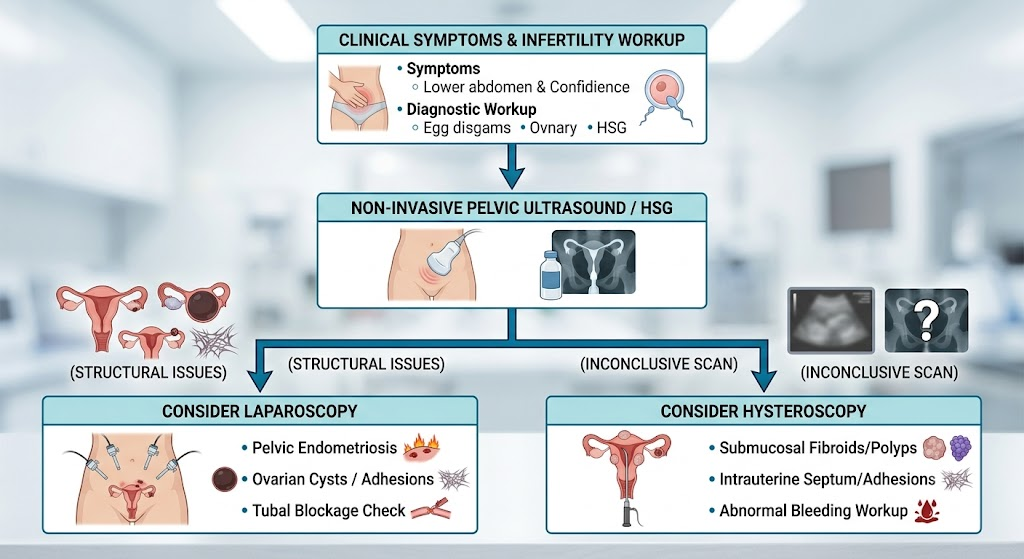
Common clinical scenarios where a doctor might recommend laparoscopy include:
- Suspected Endometriosis: Chronic pelvic pain, painful menstruation, or pain during intercourse often point toward endometriosis, which requires visual inspection for accurate staging.
- Unexplained Pelvic Pain: When lower abdominal pain persists without a clear cause on non-invasive imaging.
- Pelvic Adhesions: Previous pelvic infections or surgeries can leave scar tissue that binds organs together, causing pain or mechanical infertility.
- Tubal Factor Evaluation: Checking whether fallopian tubes are open and healthy by performing a chromopertubation test during laparoscopy.
- Ovarian Pathology: Evaluating persistent ovarian cysts or structural changes requiring direct clinical assessment.
Dr. Manisha Jain emphasizes that laparoscopic procedures are recommended strictly on an individualized basis after reviewing non-invasive options first.
When Might a Doctor Recommend Hysteroscopy?
Hysteroscopy focuses purely on the inside of the womb. A specialist may suggest this procedure when symptoms point toward an intrauterine issue.
Key situations where hysteroscopy is recommended include:
- Investigating Abnormal Bleeding: Unexplained heavy, prolonged, or postmenopausal bleeding.
- Identifying Uterine Polyps and Fibroids: Detecting lesions growing inside the uterine cavity that interfere with embryo implantation.
- Assessing Uterine Septums: Diagnosing congenital partitions inside the womb that contribute to recurrent miscarriages.
- Evaluating Intrauterine Adhesions: Identifying bands of scar tissue inside the uterus that restrict normal menstrual flow and fertility.
Patients consulting with a hysteroscopy specialist in Chandigarh benefit from clear differentiation between diagnostic hysteroscopy (used purely to examine) and operative hysteroscopy (used to treat findings simultaneously).
How to Choose the Best Laparoscopy & Hysteroscopy Diagnostic Centres in Chandigarh
Finding the best laparoscopy & hysteroscopy diagnostic centres in Chandigarh requires evaluating clinical standards, safety protocols, and medical expertise rather than relying on promotional claims.
Key factors to consider include:
- Doctor’s Qualifications and Expertise: The skill and experience of the operating laparoscopic gynecologist in Chandigarh are critical for accurate diagnosis and patient safety.
- Advanced Equipment & Technology: Facilities equipped with modern high-definition cameras, specialized light sources, and fine instrumentation allow for precise visualization.
- Infection Prevention Standards: Rigorous sterilization protocols and clean modular operation theaters reduce post-procedure infection risks.
- Anesthesia and Recovery Facilities: Access to qualified anesthetists, dedicated day-care recovery rooms, and trained nursing staff ensures patient comfort.
- Transparent Communication and Consent: Top diagnostic facilities provide clear explanations of procedure benefits, risks, and post-procedure care without hidden costs.
Evaluating these parameters ensures that patients selecting the best laparoscopy & hysteroscopy diagnostic centres in Chandigarh receive high standards of care.
Benefits and Limitations of Diagnostic Endoscopy
Understanding both the capabilities and the limits of these procedures helps set realistic expectations.
Key Benefits
- Direct High-Definition Visualization: Provides unparalleled visual clarity compared to indirect imaging.
- Simultaneous Diagnosis and Treatment: If a minor polyp, adhesion, or small endometriotic spot is found, it can often be treated during the same session (“see-and-treat” approach).
- Minimally Invasive: Smaller incisions mean minimal scarring, reduced post-procedure discomfort, and quick return to daily routines.
Clinical Limitations
- Requires Anesthesia: Unlike non-invasive scans, both procedures require local, regional, or general anesthesia.
- Surgical Risks: Although rare when performed by experienced hands, minor risks of bleeding, infection, or adjacent tissue injury exist.
- Not Always Necessary: Many gynecological issues can be successfully diagnosed and managed using standard, non-surgical methods.
Preparation Before the Procedure
Proper preparation ensures patient safety and smooth procedural execution at the best laparoscopy & hysteroscopy diagnostic centres in Chandigarh.
Typical preoperative steps recommended by Dr. Manisha Jain include:
- Medical History Review: Disclosing all current medications, blood thinners, allergies, and prior surgical histories.
- Pre-Procedure Testing: Routine blood work, coagulation profiles, and baseline health checks.
- Fasting Instructions: Following specific fasting guidelines (usually 6–8 hours prior) if general anesthesia or sedation is planned.
- Scheduling Around Menstrual Cycles: Diagnostic hysteroscopy is typically scheduled during the early follicular phase (just after menstruation ends) for optimal uterine cavity visualization.
- Arranging Transportation: Patients must arrange for a family member or escort to accompany them home following day-care discharge.
Recovery and Aftercare
Recovery timelines vary based on whether the procedure was diagnostic or operative, as well as individual patient factors.
What to Expect During Recovery
- Diagnostic Hysteroscopy: Most patients experience mild cramping or light spotting for 1–2 days and can resume normal activities almost immediately.
- Diagnostic Laparoscopy: Mild abdominal soreness, shoulder tip pain (caused by carbon dioxide gas used during the procedure), and light fatigue are common for 2–4 days.
Warning Signs Requiring Immediate Medical Attention
Patients should contact their medical team immediately if they experience:
- Severe or worsening abdominal pain not relieved by medication
- Heavy vaginal bleeding (soaking more than one pad per hour)
- High fever or chills
- Persistent nausea or vomiting
- Difficulty breathing or dizziness
The Role of Dr. Manisha Jain in Gynecological Care
Selecting an experienced practitioner is vital when seeking care at the best laparoscopy & hysteroscopy diagnostic centres in Chandigarh. Dr. Manisha Jain provides patient-centric, evidence-based care focused on individual needs.
With extensive clinical practice in minimally invasive gynecological procedures, Dr. Manisha Jain ensures that every diagnostic recommendation is justified, clearly explained, and aligned with international medical guidelines. Patient consultations prioritize empathetic listening, thorough diagnostic workups, and collaborative decision-making, ensuring women feel supported throughout their diagnostic journey.
Questions to Ask Before Your Procedure
When preparing for a consultation at one of the best laparoscopy & hysteroscopy diagnostic centres in Chandigarh, asking thoughtful questions helps clarify your care plan:
- Why is this specific procedure recommended for my symptoms?
- Are there non-surgical diagnostic alternatives available in my case?
- Will this be a diagnostic-only procedure, or can minor findings be treated at the same time?
- What type of anesthesia will be used during the test?
- What is the expected recovery timeline before I can return to work?
- When and how will we review the diagnostic findings and next steps?

Conclusion
Choosing the best laparoscopy & hysteroscopy diagnostic centres in Chandigarh is an important step toward getting clear answers for complex reproductive health and fertility concerns. Both diagnostic laparoscopy and hysteroscopy offer invaluable visual insights that guide effective, targeted treatments. By consulting a dedicated gynecologist like Dr. Manisha Jain, patients receive personalized attention, precise evaluations, and trusted care every step of the way.
If you have been advised to undergo a diagnostic evaluation or wish to discuss persistent gynecological symptoms, schedule an expert consultation with Dr. Manisha Jain today to explore your options with confidence.
Frequently Asked Questions (FAQs)
1. Are diagnostic laparoscopy and hysteroscopy painful?
Diagnostic procedures are performed under appropriate local, regional, or general anesthesia to ensure you remain completely comfortable. Mild cramping or light abdominal soreness after the procedure is normal and typically resolves within a few days with standard pain management.
2. Can laparoscopy and hysteroscopy be performed together in one session?
Yes. When evaluating complex issues like unexplained infertility or recurrent miscarriages, combining laparoscopy and hysteroscopy allows your doctor to assess both the external pelvic environment and the internal uterine cavity during a single anesthesia setting.
3. How long does recovery take after a diagnostic hysteroscopy?
Recovery after a diagnostic hysteroscopy is usually very fast. Most women experience light spotting for a day or two and are able to return to their normal daily activities within 24 to 48 hours.
4. Will diagnostic laparoscopy leave visible scars on my abdomen?
Diagnostic laparoscopy uses tiny keyhole incisions (usually 5 to 10 millimeters in size). These tiny surgical marks heal quickly and fade significantly over time, leaving minimal to barely visible scarring.
5. How do I know if I need laparoscopy instead of a standard ultrasound?
A pelvic ultrasound is usually the first non-invasive step in any evaluation. However, if ultrasound results remain inconclusive or if your doctor suspects conditions like mild endometriosis, subtle pelvic adhesions, or tubal blockages, a diagnostic laparoscopy may be recommended for direct visual confirmation.
